Employment Standards for Stage Managers

The following is an overview of provincial Employment Standards (ES) for Stage Managers. Although all references are to the CTA, what follows applies equally to stage managers working under the CTA and as employees under the ITA.

Please note: all example OT rates here are roughly based on the 2023-2024 CTA rates. Please adjust to reflect your current rate for any calculations.

Important Notes

CTA Overtime Rate vs. ES Overtime Rate

The CTA establishes overtime rates for most activities, including some for which ES legislation may not require the payment of overtime. For 2023-2024, the regular overtime rate is $17.00 for the first half hour in the day, and $20.75 for each half hour after that, for most Sector 1 (not-for-profit) theatres. Theatre for Young Audiences and Sector 2 (commercial) theatres have different rates. Please refer to Schedule ‘A’ of the Fee Booklet for full details on all of the current overtime rates.

In most cases, the ES overtime rate is defined as: weekly salary ÷ weekly hours that ES legislation allows before overtime is payable × 1.5

For example:

  • $1000/wk with a 44 hour threshold (e.g. Ontario, New Brunswick)
    1000 ÷ 44 × 1.5 = $34.09
  • $1300/wk with a 44 hour threshold
    1300 ÷ 44 × 1.5 = $44.31
  • $1300/wk with a 40 hour threshold (e.g. Manitoba)
    1300 ÷ 40 × 1.5 = $48.75

Note from these examples that the ES rate may be either higher or lower than the CTA rate. This difference is important.

Calculating Overtime

If only one type of overtime applies, then the applicable rate is paid.

For example:

  • Excess rehearsal is worked, but the weekly ES threshold is not exceeded — CTA overtime is paid
  • There is no excess rehearsal, but the weekly ES threshold is exceeded — ES overtime is paid

When both rates apply

This is where things get complicated, because many weeks contain a combination of single applicability and double applicability. For time periods where both types of overtime apply, then only the higher rate is paid (a.k.a. “no double-dipping”). It’s easiest to explain this through examples.

Case 1

For this example, we’ll assume that the stage manager has worked a basic 54-hour week, including 4 hours of cueing, that the salary is $1000/wk and that they are working in a province where the overtime threshold is 44 hours.

Let’s also assume that the hours broke down this way:

  • Rehearsal — 42 hours
  • Prep — 8 hours
  • Cueing — 4 hours

In this case, there would be no CTA overtime payable for the rehearsal hours, since these would not have exceeded the hours available for the actors. Nor would there be CTA overtime for the prep, since prep did not exceed the basic allowance.

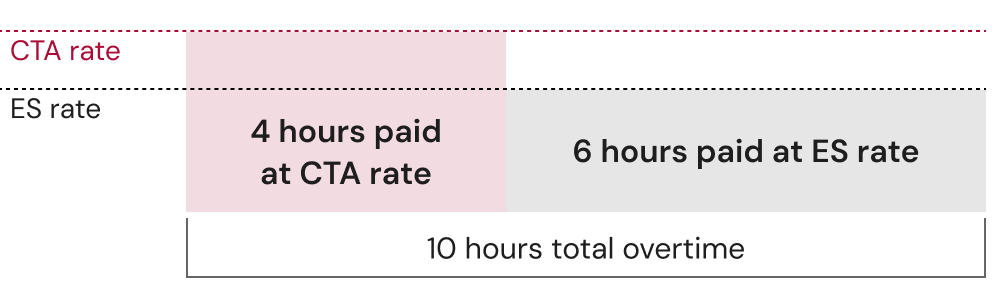
CTA overtime would be payable for the 4 hours of cueing, since these would have exceeded the hours available for the actors. Therefore, CTA overtime for this week would be $162.25 for four hours (1 half-hour at $17.00 + 7 half-hours at $20.75).

Since ES overtime is calculated on the total work hours per week, ES legislation would require payment for 10 hours. Four hours would already have been paid according to the CTA, and at a higher rate, so the remainder owing would be 6 hours at the ES rate of $34.09, totaling $204.54. Total overtime actually paid, from both sources, is $366.79.
Case 2

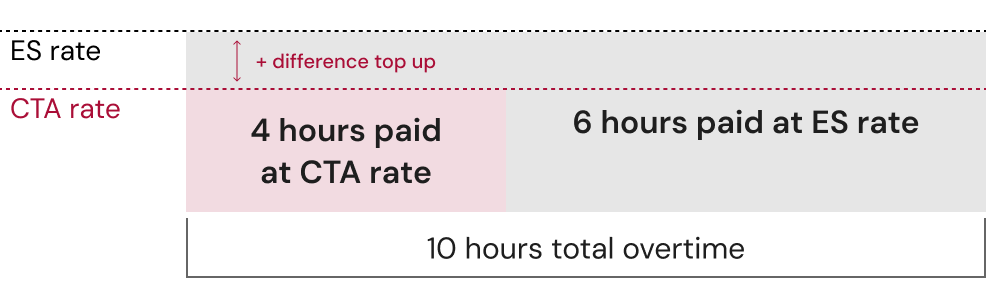
Now consider the same week at a salary of $1300/wk. As before, CTA overtime would apply to the 4 hours of cueing, since these would have exceeded the hours available for the actors. Therefore, CTA overtime for this week would still be $162.25 for four hours (1 half-hour at $17.00 + 7 half-hours at $20.75).

Once again, ES legislation would require payment for 10 hours. However, the higher salary raises the ES overtime rate to $44.31 per hour (or $177.24 for 4 hours). Since this rate exceeds the CTA rate of $162.25 for the same period, the Artist must be paid the difference of $14.99 to top up to the ES rate for these four hours.

The remainder owing would continue to be 6 hours at the ES rate, or $265.86. Total overtime actually paid is $443.10.

Averaging overtime

In some provinces, employers may be able to average work hours over a period of several weeks when calculating ES overtime. Averaging serves to level out some of the overtime peaks. Depending on the province, the use of averaging may require the permission of the Ministry of Labour and/or Equity.

The averaging period varies from Engager to Engager, depending on the province. They can range from as short as two weeks to as long as the entire contract. The use of averaging must be declared in a rider to the engagement contract, or averaging cannot be applied.

Under an averaging agreement, the application of ES overtime is the same, but calculated over a longer span.

Case 3

For this example, we’ll use the same parameters as the previous case, but averaged over 4 weeks. The following table presents an example set of hours:

HoursWeek 1 (Rehearsal)Week 2 (Rehearsal)Week 3 (Tech)Week 4 (Performance)Total

Rehearsal / Performance

42

42

48

25

157

Prep

6

9

8

9

32

CTA Overtime

4

4

Weekly Total

48

51

60

34

193

In a province where the overtime threshold is 44 hours, the SM could work a total of 176 hours in 4 weeks before ES overtime is payable. In this example, the SM worked 17 more hours than that. Since 4 hours of CTA overtime had already been paid, the employer must pay 13 more hours of ES overtime at the end of the averaging period. If the ES rate is higher than the CTA rate, the employer must also pay a retroactive top-up on the already-paid CTA overtime, to bring that rate up to the ES rate.

Note that while ES overtime is only calculated and paid at the end of an averaging period, applicable CTA overtime must still be paid weekly. Also, an averaging agreement may not reduce overtime stipulated in the CTA. Any adjustment is calculated at the end of each averaging period.

ES overtime calculations under averaging can get quite complicated, particularly over longer periods — ask your engager to supply a breakdown of how the overtime was calculated, if they do not already provide this.

Time off in lieu of overtime

In some provinces, employers may be able to provide time off in lieu of paying ES overtime. Depending on the province, the use of time off in lieu may require the permission of the Ministry of Labour and/or Equity. Time off in lieu arrangements must be declared in a rider to the engagement contract. Note that time off in lieu is different from averaging hours, but it is easy to confuse the two.

As with averaging, time off in lieu is calculated at the end of a specified period, usually the entire contract. However, the ES overtime payable at the end is reduced by any time you were released from actual work that was being done. As an example, you could be released from a rehearsal call and have that apply against the ES overtime owing; you cannot be “released” from work that could have been scheduled if needed, but was not (such as unused rehearsal time in the week, or unused prep time).

Unused hours “cancel out” ES overtime hours. For example, in Ontario, 1½ unused hours cancel out 1 ES overtime hour. Note that this does not reduce overtime stipulated in the CTA.

Since time off in lieu calculations can get quite complicated, particularly over longer periods — ask your engager to supply a breakdown of how time off in lieu was applied, if they do not already provide this, or contact a business rep for more clarification.

Other ES overtime arrangements

The overtime arrangements described above represent the most common situations across the country. However, there may be overtime arrangements in your workplace that differ from these. If faced with an unusual overtime arrangement, your best resource for information is an Equity Business Rep. Give them a call to confirm Equity’s interpretation of how the ES overtime rules apply.

Additional Factors

Equity’s agreements and policies require that the Engager must notify a SM regarding any permits related to allowable working hours in a day or week that may affect the artist’s working conditions in advance of signing an engagement contract. This information must also be included in a rider affixed to the artist’s engagement contract, outlining how ESA overtime is administered by the Engager, any applicable averaging cycle, and the timing of payment of ESA overtime to the artist. Members are encouraged to email a Business Rep with any questions about engagement contract riders and ESA arrangements currently in effect.

How do payments for excess span of day figure into all of this?

Payment for excess span is treated the same way as any other CTA overtime. Hours of excess span may be deducted from the ES overtime payable. If the CTA rate is higher than the applicable ES rate, then the CTA rate applies. If the applicable ES rate is higher, then excess span must be paid at the higher rate. Graphically, these situations are identical to those shown in Case 1 and Case 2, respectively.

How does ES affect payments for invasion of meal breaks and overnight rest?

Not at all. In addition to overtime rates, the CTA sets some penalty payments for invasion of rest and meal breaks. Note that these are payments for insufficient break time, not payments for excess work hours. In all cases, these penalty payments are made in addition to any overtime of either sort that may be owing.

What if I am not certain that overtime has been correctly paid?

Short and sweet — call the Business Rep for your production and have them review the numbers. This summary gives a general overview of the topic, but an Equity Business Rep is your best resource for working out the details of a specific case. The staff at either Equity office can direct you to the best resource person for your contract.

Employment Standards Across Canada

Since ES legislation varies across the country, this summary cannot possibly address all circumstances. To complete the picture, members need to understand the specific provisions of ES legislation in the province in which the work is being done. Click on a province below for details on the applicable Employment Standards.

Have questions or need more information?

Contact Us

National Office

44 Victoria St, 12th Floor

Toronto, ON M5C 3C4

Phone

416-867-9165

1-800-387-1856